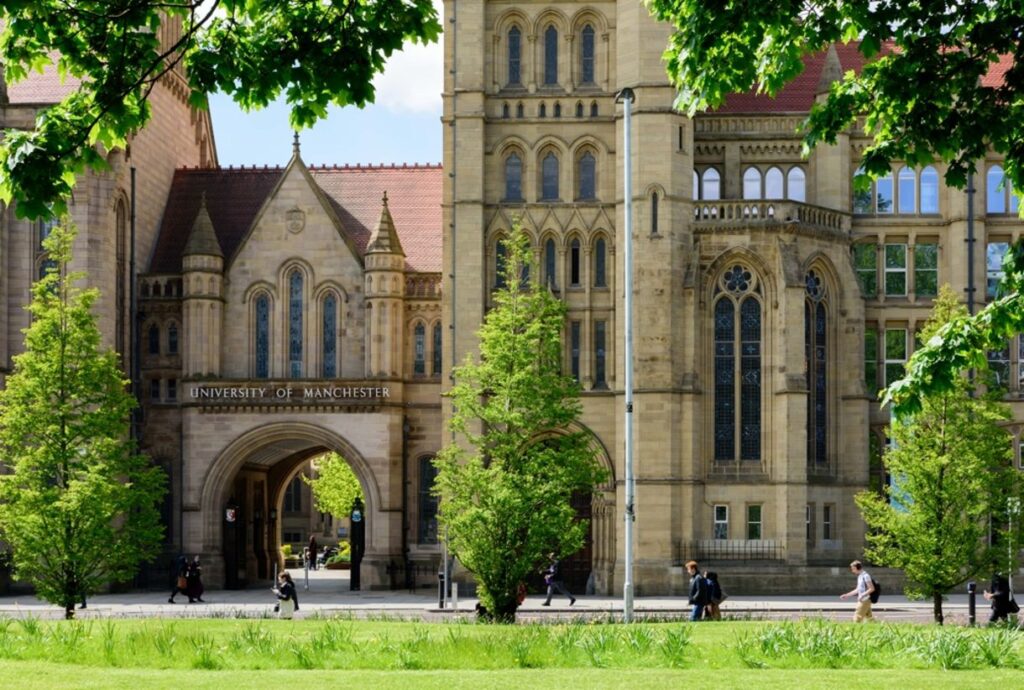
The University of Manchester, one of the UK’s leading research universities, has announced fully funded PhD opportunities for international students through its prestigious President’s Doctoral Scholar (PDS) Award programme for the 2027/28 academic year. At least 12 scholarships have been identified across two faculties: seven in the Faculty of Humanities and five in the Faculty of Biology, Medicine and Health. The University also offers President’s Doctoral Scholar opportunities through its Faculty of Science and Engineering, with separate project and application arrangements. These scholarships provide full tuition fee coverage, including international tuition fees, an annual living stipend at the UKRI rate and an additional £1,000 annual stipend enhancement.
For the 2026/27 academic year, the UKRI doctoral stipend rate is £21,805. With the additional £1,000 enhancement, this represents £22,805 per year, although the actual 2027/28 stipend will depend on the applicable UKRI rate.
The University has announced the theme “Sensing the World” for its 2027 doctoral scholarship opportunities. The programme brings together researchers from different academic disciplines to investigate how people, technologies and systems sense, interpret and respond to the world around them.
Applications for the 2027 intake begin opening from 30 October 2026, with a published deadline of 18 December 2026 for the Humanities and Biology, Medicine and Health opportunities.
These scholarships are particularly attractive to international students because they cover overseas tuition fees as well as providing financial support for living expenses over several years.
In this article, we explain the scholarship benefits, available research opportunities, academic eligibility, step-by-step application process, important deadlines and practical tips for submitting a competitive application. We also answer frequently asked questions to help international applicants prepare.
Scholarship overview
| Scholarship information | Details |
|---|---|
| Scholarship name | President’s Doctoral Scholar Award |
| University | University of Manchester |
| Country | England, United Kingdom |
| Qualification | PhD / Doctoral Research |
| Academic year | 2027/28 |
| Confirmed scholarships | 7 in Humanities and 5 in Biology, Medicine and Health |
| Additional opportunities | Faculty of Science and Engineering: 8–10 projects for 2027/28 (deadline not yet published) |
| Eligible applicants | UK and international students |
| Tuition fees | Fully covered at home or international rate |
| Annual stipend reference | £21,805 (2026/27 UKRI rate) |
| Additional stipend enhancement | £1,000 per year |
| Indicative combined annual stipend | £22,805 based on 2026/27 rates |
| Funding duration | Generally 3.5 to 4 years, depending on the award |
| Research theme | Sensing the World |
| Application opening | From 30 October 2026, depending on Faculty |
| Published application deadline | 18 December 2026 for Humanities and Biology, Medicine and Health |
| Expected start | Autumn 2027 |
| Selection | Academic excellence, research potential and interview |
What is the President’s Doctoral Scholar Award?
The President’s Doctoral Scholar Award is one of the University of Manchester’s flagship doctoral funding initiatives.
The programme is supported by the University’s President and Vice-Chancellor, Professor Duncan Ivison, and is designed to attract exceptional researchers with the potential to become future leaders in their academic disciplines.
Unlike ordinary postgraduate funding arrangements, the award combines financial support with opportunities for research leadership, professional development and participation in a community of outstanding doctoral researchers.
The University places particular emphasis on ambitious interdisciplinary research.
This means that doctoral researchers are encouraged to work across traditional academic boundaries and investigate problems that require expertise from more than one field.
For international students interested in research with real-world significance, this provides an opportunity to work alongside academics from different disciplines.
How many scholarships are available for 2027?
The University has published specific scholarship allocations within two of its academic faculties.
| Faculty | Published 2027 scholarships |
|---|---|
| Faculty of Humanities | 7 |
| Faculty of Biology, Medicine and Health | 5 |
| Faculty of Science and Engineering | 8–10 projects listed; projects and deadline not yet published |
| Confirmed across the first two faculties | 12 |
The number of scholarships is important because doctoral funding opportunities are highly competitive.
In Humanities, seven funded places have been announced under the 2027 research theme.
The Faculty of Biology, Medicine and Health has identified five scholarships for 2027/28.
The Faculty of Science and Engineering also participates in the President’s Doctoral Scholar programme, but applicants should consult its updated funding page for the current project list and number of awards.
Important: The figure of 12 represents the opportunities identified in the first two faculties, not necessarily the total number available throughout the University.
What does the scholarship cover?
The President’s Doctoral Scholar Award provides a substantial funding package that is particularly valuable for students from outside the United Kingdom.
1. Full international tuition fee coverage
Successful scholars receive full funding for their university tuition fees.
Importantly, the scholarship covers tuition fees at either the UK or international rate.
This means eligible international students do not need to pay the difference between domestic and overseas PhD tuition fees during the funded period.
For many international applicants, tuition fees represent one of the largest financial barriers to doctoral study in the United Kingdom.
The inclusion of overseas tuition fee coverage therefore makes the award especially attractive.
2. Annual living stipend
Successful applicants receive an annual maintenance stipend linked to the UK Research and Innovation (UKRI) doctoral funding rate.
The UKRI minimum stipend for the 2026/27 academic year is £21,805.
The stipend is intended to help doctoral researchers meet living expenses such as accommodation, food, local transport and other essential costs.
The stipend for 2027/28 should be checked once the applicable rate has been confirmed.
3. Additional £1,000 annual stipend enhancement
One particularly attractive feature of the President’s Doctoral Scholar Award is an additional annual stipend enhancement.
The University provides £1,000 per year on top of the standard UKRI stipend under the published scholarship arrangements.
Based on the 2026/27 UKRI rate, the financial package would therefore be:
| Funding component | Annual amount |
|---|---|
| UKRI reference stipend | £21,805 |
| Additional PDS stipend enhancement | £1,000 |
| Combined reference amount | £22,805 |
This is equivalent to approximately £1,900 per month when divided over twelve months.
However, this figure is illustrative. The final 2027/28 amount will depend on the applicable stipend rate and award conditions.
The Biology, Medicine and Health Faculty describes its stipend as tax-free, subject to the relevant scholarship and tax rules.
4. Funding for up to four years
The University provides funding for approximately 3.5 to four years, depending on the Faculty and the structure of the studentship.
For example, the Faculty of Biology, Medicine and Health advertises a four-year fully funded award.
Applicants should verify the exact duration associated with their selected project before applying.
5. Research training and professional development
The scholarship offers more than financial support.
Successful candidates become part of the University’s Presidential Scholars community and can participate in specialist development activities.
These may cover:
- Research leadership and professional development
- Academic collaboration and interdisciplinary research
- Public engagement and science communication
- Research publications and dissemination
- Sustainability and research impact
- Commercialisation and innovation
- Career development and networking
Scholars may also have opportunities to participate in University initiatives, research showcases and events involving senior academics.
These experiences can be particularly valuable for students considering academic careers or research-intensive roles in industry.
What expenses may not be covered?
International applicants should remember that fully funded does not necessarily mean every expense is paid.
The published core funding package covers tuition fees and provides a living stipend.
Applicants may still need to budget for:
- UK Student visa fees
- Immigration Health Surcharge
- International travel
- Accommodation deposits
- Relocation expenses
- Personal and family-related costs
Students should contact the relevant Faculty to establish whether any project-specific funding is available for additional expenses.
Can international students apply?
Yes. The President’s Doctoral Scholar Award is open to applicants of all nationalities.
This includes eligible applicants from countries such as Bangladesh, India, Pakistan, Nepal, Sri Lanka, Nigeria, Ghana, Kenya and other countries outside the United Kingdom.
There is no general nationality restriction under the scholarship programme.
However, applicants must satisfy the academic and research requirements associated with their chosen project and Faculty.
International qualifications are assessed against the University’s degree equivalency and programme admission requirements.
Applicants should therefore verify whether their academic qualifications meet the criteria before applying.
Academic eligibility requirements
The President’s Doctoral Scholar Award is designed for applicants with exceptional academic ability and a strong commitment to research.
Although requirements vary somewhat across Faculties, several important conditions apply.
1. Strong undergraduate qualifications
The Faculty of Biology, Medicine and Health expects candidates to hold, or be about to obtain, a first-class honours undergraduate degree or its international equivalent.
The Faculty of Humanities also specifies a first-class bachelor’s honours degree, or overseas equivalent.
International students should not assume that a particular GPA automatically corresponds to a UK first-class degree.
The University assesses overseas qualifications according to its academic equivalency requirements.
2. Master’s-level qualifications
The expectations concerning master’s degrees vary by Faculty and programme.
The Faculty of Biology, Medicine and Health states that candidates should ideally possess a master’s-level qualification at merit or distinction, or the international equivalent.
The Faculty of Humanities requires applicants to meet the master’s-level entry requirements associated with their chosen programme.
Therefore, prospective applicants should check the relevant programme requirements carefully.
3. Evidence of research potential
Academic qualifications are important, but selection is not based on grades alone.
The University also considers whether applicants demonstrate genuine research potential.
Relevant evidence may include:
- Undergraduate or master’s dissertations
- Research assistantships and research placements
- Contributions to academic publications
- Conference presentations
- Research-related awards or prizes
- Experience communicating research to wider audiences
- Relevant professional research experience
- Strong academic references
Applicants should explain their contribution to previous research activities rather than simply listing projects in their CV.
4. Interest in interdisciplinary research
The 2027 opportunities are particularly focused on interdisciplinary research.
Applicants should be willing to engage with ideas and methodologies from different academic areas.
For example, a researcher interested in environmental health may need to combine expertise from environmental sciences, data analysis and public health.
Similarly, research involving sensing technologies may draw on computer science, engineering, psychology or medicine.
The ability to work across disciplines may therefore be an important advantage.
Research theme for 2027: Sensing the World
The University’s 2027 President’s Doctoral Scholar opportunities are organised around the theme “Sensing the World”.
The theme examines how the world is sensed and interpreted, and how those processes influence human understanding and responses to major challenges.
The University identifies challenges involving society, health, the environment, the economy and industry.
This creates opportunities for interdisciplinary research involving multiple academic fields.
Potentially relevant research areas may include:
- Artificial Intelligence and Machine Learning
- Environmental monitoring and climate research
- Health technologies and biomedical sensing
- Psychology and human perception
- Data Science and intelligent systems
- Engineering and sensor technologies
- Social science approaches to perception and experience
- Human interaction with technology
- Environmental and public health
- Digital technologies and societal change
These are examples of disciplines that may relate to the theme, not a confirmed list of funded projects.
Applicants must select an officially advertised project eligible for the President’s Doctoral Scholar Award.
Why the research theme matters
One mistake applicants sometimes make is assuming that they can submit any research idea under a broad interdisciplinary scholarship.
For the 2027 recruitment rounds, the University is advertising particular supervisor-led research projects.
Applicants should therefore begin by examining the available project descriptions.
The most competitive applications are likely to demonstrate a convincing connection between the applicant’s background and the requirements of the selected project.
How to apply for the President’s Doctoral Scholar Award
The application process requires careful preparation.
Unlike scholarship programmes where students can submit a general funding application and choose a research topic later, the published Manchester recruitment process centres on specific advertised PhD projects.
The following guide explains the main stages.
Step 1: Identify the appropriate Faculty
Begin by deciding which Faculty best matches your academic background and research interests.
The three main Faculties participating in the programme are:
- Faculty of Humanities
- Faculty of Biology, Medicine and Health
- Faculty of Science and Engineering
Each Faculty publishes its own opportunities and application instructions.
Applicants should not assume that every Faculty follows identical procedures.
Step 2: Find an advertised PhD project
Once you have selected the appropriate Faculty, browse its available President’s Doctoral Scholar projects.
The 2027 projects in Humanities were scheduled for announcement on 30 October 2026.
The Faculty of Biology, Medicine and Health has stated that its projects will be advertised during the week beginning 2 November 2026.
Read the available project descriptions carefully.
Pay particular attention to:
- The central research problem
- Project objectives
- Required academic background
- Research methods
- Expected technical or subject knowledge
- Supervisory team
- Application requirements
It is important to select a project that matches both your existing skills and future research ambitions.
Step 3: Contact the potential supervisor
For applicants to the Faculty of Biology, Medicine and Health, contacting the prospective supervisor is an important part of the recommended application process.
Once you have identified a suitable project, contact the listed academic supervisor.
Introduce yourself and explain why the project interests you.
A professional introductory email might include:
- Your name and current academic position
- Your undergraduate and postgraduate qualifications
- Your previous research experience
- The particular project you are interested in
- Why your background is relevant
- Your intention to apply for the President’s Doctoral Scholar Award
Attach an academic CV if appropriate.
The purpose of this communication is to establish a meaningful connection with the research project and clarify whether your experience is suitable.
Applicants should follow their Faculty’s specific rules concerning supervisor contact.
Step 4: Prepare your supporting documents
Applicants should prepare their documents well before the application deadline.
For the Faculty of Biology, Medicine and Health, the University lists the following supporting materials:
- Academic CV
- Supporting statement
- Degree certificates
- Final or interim academic transcripts
- Academic reference details
- English-language certificates, where applicable
Students who are currently completing a master’s degree may be able to provide alternative evidence of enrolment if an interim transcript is not yet available.
The University states that incomplete applications will not be processed.
Applicants should therefore check that all required documents have been uploaded correctly.
Step 5: Write a strong supporting statement
The supporting statement is an important opportunity to demonstrate why you are suitable for the selected project.
Unlike a generic personal statement, it should explain your connection to the particular research opportunity.
A strong supporting statement should address several questions.
Why are you interested in this project?
Explain which aspects of the research problem interest you and why they are academically or practically significant.
How does your academic background prepare you?
Discuss relevant modules, dissertation work, research experience or professional activities.
What research skills can you contribute?
Identify methods, technical skills or research approaches that may be useful for the project.
Why do you want to pursue doctoral research?
Explain your motivation and longer-term research ambitions.
Why is the University of Manchester suitable for your research development?
Demonstrate that you understand the research environment and the relevance of the supervisory team.
Applicants should avoid generic statements that could be submitted to any university without modification.
Step 6: Check whether a separate research proposal is required
For the Faculty of Biology, Medicine and Health’s published President’s Doctoral Scholar application route, a separate research statement is not required.
This is important because the programme recruits students to predefined supervisor-led projects.
However, requirements may differ across other Faculties.
Applicants should not spend time preparing a lengthy independent research proposal unless the relevant Faculty or project specifically requests one.
Step 7: Submit the online PhD application
Applicants should submit their application through the University of Manchester’s official postgraduate application system.
Official application portal:
https://www.manchester.ac.uk/study/postgraduate-research/admissions/how-to-apply/
Select the relevant postgraduate research programme and follow the instructions provided for the advertised project.
For the Faculty of Biology, Medicine and Health, the published guidance instructs applicants to identify the main supervisor and indicate the President’s Doctoral Scholar Award in the funding section.
The guidance specifies the following funding information:
- Funding: Yes
- Type of funding: Uni of Manchester scheme
- Awarding body: President’s Doctoral Scholar Award
- Funding covers: Fully Funded
The University’s published instructions also refer to selecting “Awarded” as the funding status. Applicants should follow the current Faculty guidance and seek clarification if this field is confusing, rather than treating the selection as confirmation that they have already received an award.
Some published form instructions still contain previous academic-year references. Applicants should ensure that their selected intake corresponds to the intended 2027 entry before submission.
Step 8: Prepare for the scholarship interview
Shortlisted candidates may be invited to interview.
For the Faculty of Biology, Medicine and Health, interviews are conducted online through Microsoft Teams.
The interview panel may include up to three academic staff members from across the University.
Applicants are expected to deliver a short presentation lasting no more than ten minutes about their chosen research project.
This may be delivered using PowerPoint or as a verbal presentation.
Candidates should be prepared to discuss:
- Their understanding of the research problem
- The project’s potential significance
- Relevant academic background
- Previous research experience
- Research methodology
- Potential challenges
- Motivation for doctoral study
- Why they are suitable for the project
The recruitment committee subsequently evaluates candidates using their interview performance, academic record, CV and references.
Important application dates for 2027 entry
The application timetable is especially important for international applicants who need to prepare academic documents and references.
| Activity | Published date |
|---|---|
| Humanities applications open | 30 October 2026 |
| Biology, Medicine and Health applications open | Week beginning 2 November 2026 |
| Application deadline for these two Faculties | 18 December 2026 |
| Humanities interviews | Week beginning 1 March 2027 |
| Biology, Medicine and Health interviews | Week beginning 8 March 2027 |
| Expected scholarship outcomes | Week beginning 15 March 2027 |
| Science and Engineering deadline | Not yet published (projects “will be advertised soon”) |
| PhD commencement | Autumn 2027 |
Applicants interested in Science and Engineering should consult that Faculty’s updated recruitment timetable separately.
Why you should apply early
International applicants may need additional time to obtain transcripts, request academic references and prepare English-language documentation.
Contacting prospective supervisors can also take time.
For these reasons, applicants should avoid leaving their application until the final days before the deadline.
Submitting early also provides an opportunity to identify missing documents and resolve administrative issues.
How competitive are these scholarships?
The President’s Doctoral Scholar Award is one of the University’s flagship doctoral funding programmes.
The limited number of scholarships and the emphasis on academic excellence mean that competition is likely to be strong.
However, selection is not simply a matter of achieving the highest academic grades.
Candidates must also demonstrate the research skills, motivation and potential required for the specific project.
The interview provides another opportunity to demonstrate research understanding, independent thinking and communication skills.
A successful application will normally need to show a strong match between the applicant’s background and the proposed research.
Practical tips for international students
1. Choose the project carefully
Do not apply only because a project offers full funding.
Study the research objectives and consider whether the project genuinely matches your interests and skills.
A good research match is likely to help you produce a stronger supporting statement and perform more confidently at interview.
2. Demonstrate research experience
Explain what you have actually done in previous research projects.
For example, rather than simply stating that you completed a dissertation, describe the research questions, methods, analysis and conclusions.
If you encountered challenges, explain how you addressed them.
This can help demonstrate independence and problem-solving ability.
3. Understand the interdisciplinary nature of the project
Because the 2027 opportunities emphasise interdisciplinary research, applicants should be prepared to explain how different academic fields may contribute to the project.
You do not need to be an expert in every discipline involved.
However, demonstrating curiosity and willingness to engage with unfamiliar methods may strengthen your application.
4. Write a tailored supporting statement
Avoid submitting the same statement for several unrelated research projects.
Explain precisely why you are interested in the selected project and how your academic background relates to it.
Where appropriate, refer to relevant research methods, literature or project objectives.
5. Select strong academic referees
Choose referees who know your academic work well.
A useful reference should provide meaningful information about your research abilities, academic strengths and potential for doctoral study.
Contact your referees early and give them sufficient information about the scholarship and the project.
6. Prepare for the ten-minute research presentation
For the Biology, Medicine and Health interview route, candidates should prepare a clear presentation that remains within the ten-minute limit.
A useful structure is:
- Introduction to the research problem
- Why the problem matters
- Relevant academic background
- Understanding of the proposed approach
- Expected challenges and potential contributions
- Why you are suited to the project
Keep the presentation focused and avoid overcrowding slides with text.
7. Prepare for research-based interview questions
Interviewers may test your understanding of the research project and your ability to think critically.
Prepare to explain not only what the project intends to investigate, but also why the chosen approach may be appropriate.
If you do not know an answer, it is better to demonstrate a thoughtful approach than to make unsupported claims.
8. Check international qualification equivalencies
Degree classifications differ significantly between countries.
Applicants should check whether their qualifications satisfy the University’s academic criteria.
If you are uncertain, contact the relevant Faculty admissions team.
9. Do not confuse admission with funding
An application for postgraduate research admission does not automatically guarantee a funded scholarship.
Applicants must follow the specific President’s Doctoral Scholar recruitment procedure and complete any required funding-related sections.
10. Keep track of Faculty-specific instructions
The University operates the scholarship programme through its different Faculties.
Application dates, project availability and documentation requirements may vary.
Always use the instructions applicable to your chosen project.
Frequently asked questions
1. Are the University of Manchester President’s Doctoral Scholar Awards fully funded?
Yes. The advertised awards provide full tuition fee coverage and an annual living stipend, with an additional £1,000 stipend enhancement.
2. Can international students apply?
Yes. The President’s Doctoral Scholar Award is open to applicants of all nationalities, subject to project-specific and academic requirements.
3. Are international tuition fees covered?
Yes. The University confirms that the funding covers tuition fees at the home or international rate.
4. How many scholarships are available for 2027?
The University has identified seven scholarships in Humanities and five in Biology, Medicine and Health, giving 12 across these two Faculties. Science and Engineering opportunities are advertised separately, so the University-wide total may be higher.
5. How much is the annual stipend?
The 2026/27 UKRI stipend is £21,805. The additional £1,000 scholarship enhancement gives an illustrative combined amount of £22,805 per year. The applicable rate for 2027/28 should be confirmed before applicants make financial commitments.
6. How long is the scholarship funded?
The funding period is generally between 3.5 and four years, depending on the Faculty and project.
7. Is the scholarship open to students from Bangladesh, India, Pakistan and Nigeria?
Yes. Applicants from these countries may apply if they satisfy the relevant academic and project requirements.
8. Is a first-class undergraduate degree required?
The published Humanities and Biology, Medicine and Health criteria specify a first-class honours degree or international equivalent. Other Faculty requirements should be checked separately.
9. Do I need a master’s degree?
Master’s-level requirements vary by Faculty and programme. Applicants should consult the eligibility requirements for their chosen project.
10. Do I need to publish research papers before applying?
The programme values evidence of research engagement, which may include publications, research projects, presentations and awards. A universal requirement to have published papers is not stated in the reviewed Faculty guidance.
11. Can I apply without IELTS?
Applicants must satisfy the English-language requirements of the chosen programme. Whether a test is necessary depends on the University’s accepted qualifications and exemption rules.
12. Do I need to contact a supervisor before applying?
The Faculty of Biology, Medicine and Health recommends contacting the supervisor associated with the advertised project before applying. Other applicants should follow their Faculty’s instructions.
13. Do I need to prepare my own research proposal?
Not necessarily. The Biology, Medicine and Health recruitment route is based on advertised projects and explicitly states that a separate research statement is not required. Other Faculties may have different requirements.
14. Can I apply for more than one project?
The Faculty of Biology, Medicine and Health permits applications for up to two projects. Separate applications and tailored supporting statements are required for each.
15. Is there an interview?
Shortlisted applicants may be interviewed. For Biology, Medicine and Health, interviews are held online and include a short research presentation.
16. When is the application deadline?
The published closing date for Humanities and Biology, Medicine and Health is 18 December 2026. Science and Engineering, which lists eight to ten projects for 2027/28, has not yet published its deadline; check the Faculty’s page.
17. When will successful applicants be informed?
Humanities and Biology, Medicine and Health anticipate informing applicants of outcomes during the week beginning 15 March 2027.
18. When does the PhD begin?
The advertised opportunities are intended for autumn 2027 entry. Individual projects may specify their expected start dates.
19. Can I apply from outside the United Kingdom?
Yes. International students can apply from overseas through the University’s online application system.
20. Does the scholarship cover visa fees and international travel?
The core advertised package covers tuition fees and a living stipend. Applicants should not assume that visa fees, health surcharge costs or international travel are covered unless the particular award explicitly provides additional support.
Official University links
Applicants should use the following official University of Manchester resources to check details and complete their applications.
1. President’s Doctoral Scholar Award – Main scholarship page
https://www.manchester.ac.uk/study/postgraduate-research/funding/presidents-doctoral-scholar-award
This is the University’s central information page for the scholarship.
2. Faculty of Humanities – President’s Doctoral Scholar Award
This page provides information about the seven Humanities scholarships, funding, eligibility and application deadlines.
3. Faculty of Biology, Medicine and Health – President’s Doctoral Scholar Award
This page contains eligibility requirements, funding information, project announcements, application instructions and interview arrangements.
4. Faculty of Science and Engineering – President’s doctoral scholarship
Applicants interested in science and engineering should check this page for updated scholarship opportunities.
5. University of Manchester – Postgraduate research application portal
https://www.manchester.ac.uk/study/postgraduate-research/admissions/how-to-apply/
Applicants can use the University’s official application system to submit their postgraduate research applications.
6. University of Manchester – Postgraduate research funding
https://www.manchester.ac.uk/study/postgraduate-research/funding
This page provides information about other doctoral funding opportunities.
Final thoughts
The University of Manchester’s President’s Doctoral Scholar Award offers a valuable opportunity for outstanding international students who wish to pursue fully funded PhD research in the United Kingdom.
The University’s 2027 recruitment information identifies at least 12 fully funded scholarships across Humanities and Biology, Medicine and Health, with additional opportunities associated with Science and Engineering.
The scholarship package is particularly attractive because it covers full international tuition fees and provides an annual living stipend at the UKRI rate, together with a £1,000 annual enhancement.
The focus on interdisciplinary research also provides opportunities for students interested in addressing complex challenges involving health, society, technology, the environment and industry.
However, these scholarships are competitive and require careful preparation.
Applicants should identify an eligible project, confirm the academic requirements, prepare strong supporting documents and follow their Faculty’s application instructions.
The published deadline of 18 December 2026 for Humanities and Biology, Medicine and Health gives prospective applicants an important opportunity to begin preparing their applications now.
If you are an international student considering a PhD in the UK in 2027, the University of Manchester’s President’s Doctoral Scholar Award is certainly worth exploring.
For full details and the latest application information, visit the University’s official scholarship website.
Information reviewed: 31 October 2026. Scholarship numbers, application dates, funding amounts and eligibility criteria are based on published University of Manchester information and may change. Applicants should verify all details with the relevant Faculty before submitting an application.